
I started sharing about hidradenitis suppurativa online the same way most of us do — out of desperation and isolation. I was sick, figuring things out mostly on my own, and I couldn’t find anyone talking honestly about what I was experiencing. So I started talking about it myself.
What I didn’t know then is that sharing your story — consistently, and with the people who need it most — has a way of building something you never planned for.
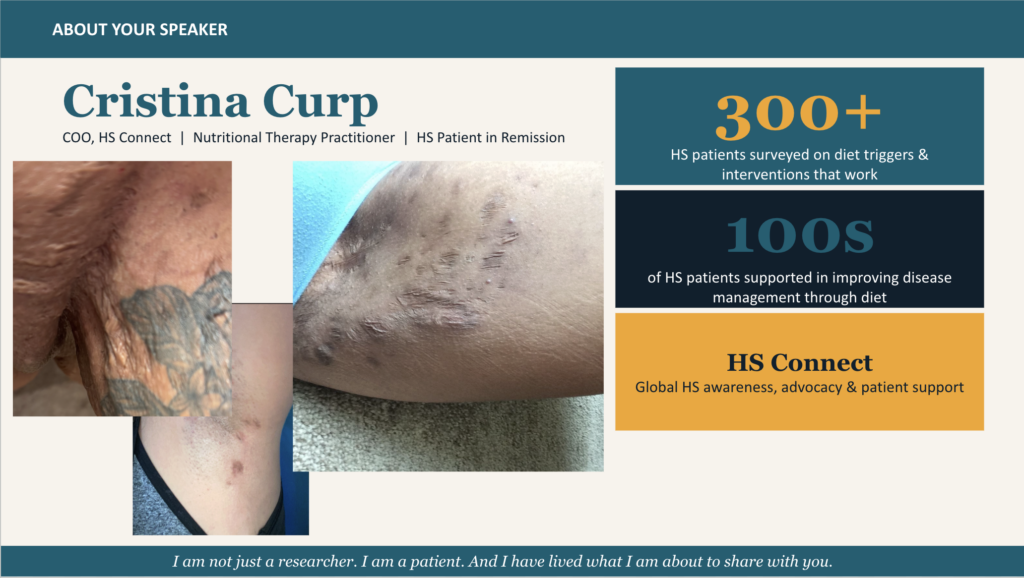
Over the years, that sharing turned into a nutrition practice. Into working alongside functional medicine doctors and Well Theory. Into surveying over 300 HS patients to understand what was actually working in our community, because the data we needed existed in us — it just hadn’t been collected yet. And it turned into my role at HS Connect, where the work of supporting patients continues every single day.
But something happened recently that stopped me in my tracks.
Dr. Keeling — an HS surgeon in Canada and one of the leading voices in this space — invited me to speak at the Canadian Hidradenitis Suppurativa Symposium. Not to share my patient story. To present the science. To stand in front of dermatologists and clinicians and walk them through the evidence on hidradenitis suppurativa diet, food triggers, and nutrition as a tool for disease management.
I spent a long time as the patient who couldn’t get a doctor to take her disease seriously, let alone her diet. And now I was being asked to educate the doctors.
That is a full-circle moment I do not take lightly.
What the Research Actually Says About HS and Nutrition
This isn’t fringe thinking. The science linking diet and hidradenitis suppurativa has grown substantially in recent years, and it points to some consistent patterns worth knowing about.
The gut microbiome matters. HS patients show measurable differences in gut microbial diversity, and recent Mendelian randomization studies suggest certain microbial patterns may actually contribute to disease risk — not just correlate with it. This is the gut-skin axis in action.
Blood sugar and dairy drive inflammation through a specific pathway. Diets high in refined carbohydrates and dairy raise insulin and IGF-1 levels, which activate mTOR — a pathway involved in both inflammation and follicular keratinization, two hallmarks of HS. This same mechanism is well established in acne research.
Food triggers are real, and dairy is consistently at the top. Across patient surveys and dietary studies — including my own survey of 300+ patients — dairy is the single most commonly reported HS food trigger. Sugar, refined carbs, alcohol, and yeast follow closely behind.
Yeast is worth paying attention to for some patients. Elevated anti-Saccharomyces cerevisiae antibodies (ASCA) have been found in HS patients and are associated with increased disease severity. In one six-year study, 70% of patients saw symptom improvement on a yeast-exclusion diet — with 87% experiencing rapid recurrence after reintroduction.
Micronutrients play a supporting role. Zinc deficiency and low vitamin D are both consistently associated with increased HS severity. These aren’t standalone treatments, but they’re low-risk adjuncts worth considering.
The overall dietary pattern matters most. HS patients tend to follow more pro-inflammatory dietary patterns — higher in ultra-processed foods and refined carbs, lower in fiber and omega-3s. Anti-inflammatory eating patterns like the Mediterranean diet are consistently associated with lower disease severity. It’s less about one trigger food and more about the overall inflammatory environment.
The Framework I Use With Patients
Rather than overwhelming people with a complete dietary overhaul, I use a four-pillar framework: Remove, Rebuild, Restore, Regulate.
Start by removing the highest-impact triggers — added sugar first, then dairy, then baker’s and brewer’s yeast. Then rebuild with fiber (targeting 25–35g daily) and omega-3 rich foods to support gut diversity and shift the inflammatory baseline. Restore with targeted micronutrients like zinc and vitamin D. And regulate blood sugar through balanced meals — protein, fiber, and healthy fat at every meal — to reduce the insulin spikes that drive the IGF-1 cascade.
It’s not a perfect plan. It’s a starting point. And starting points are what actually create change.
Why I’m Sharing This With You
I put everything I know into this presentation — not just the research, but what our community has taught me. The 300+ patient survey responses. The patterns I’ve seen in hundreds of patients. The truth that knowing what to do and actually being able to do it are two very different things, and that gap is where both clinicians and community support can make the most difference.
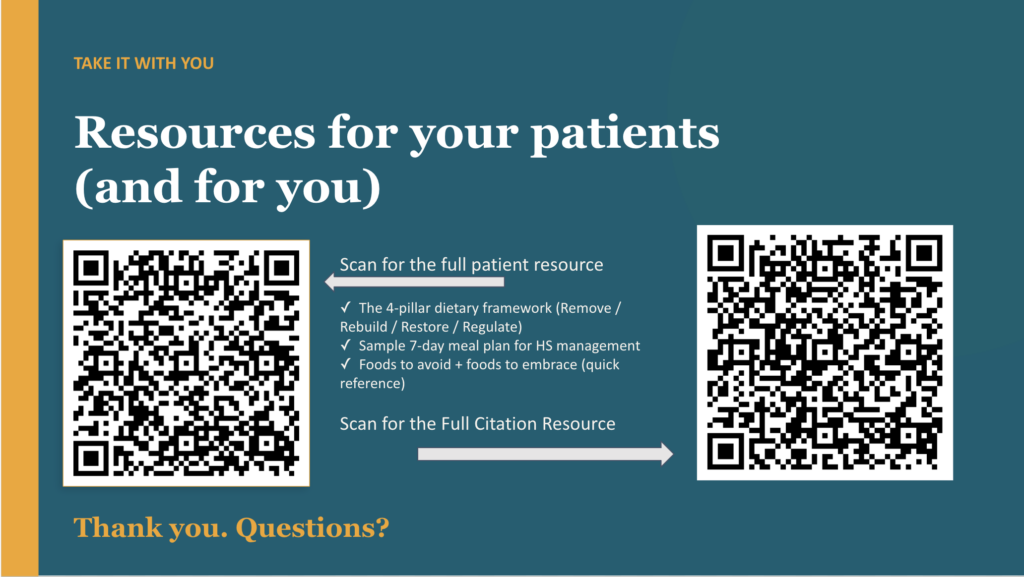
The full slide deck is available below, along with two free downloadable resources:
- A Citation Guide — all the studies referenced, with plain-language summaries
- A Patient Guide — a step-by-step guide on implementing dietary changes for managing inflammation and calming your HS
Nutrition isn’t a cure. But it is a lever. And the more people — patients and providers alike — understand that, the better care looks for all of us.
We’re getting there. I really believe that.
— Cristina